

IPP Reveals a Novel Mechanism of Rice Blast Resistance Mediated by the CCCH-Tandem Zinc Finger Protein OsTZF1
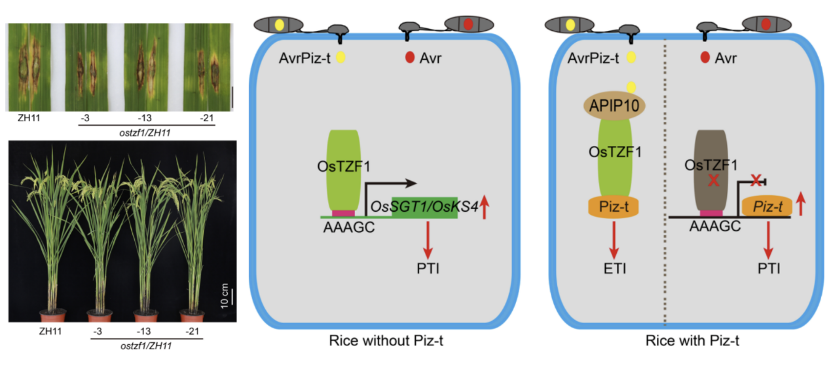
Recently, the Innovation Team for Functional Genomics of Crop Pathogens and Pests from the Institute of Plant Protection (IPP), Chinese Academy of Agricultural Sciences (CAAS), published a research paper titled “The CCCH-tandem zinc-finger protein OsTZF1 positively regulates basal immunity but suppresses Piz-t-mediated blast resistance in rice” in Plant Communications. This study systematically elucidates the novel mechanism by which the rice CCCH-tandem zinc finger protein OsTZF1 plays a key role in maintaining the balance between rice disease resistance and growth through differential regulation of basal immunity and Piz-t-mediated specific resistance. It provides new insights for crop disease-resistant breeding using NLR immune receptors.
In the long-term co-evolution between plants and pathogens, plants have developed defense systems including pathogen-associated molecular pattern (PAMP)-triggered immunity (PTI) and effector-triggered immunity (ETI). NLR immune receptors are core components of ETI; however, their expression regulatory mechanisms remain unclear. Previous studies found that the E3 ubiquitin ligase APIP10 negatively regulates the accumulation of the NLR protein Piz-t, but there is no direct interaction between them—suggesting the existence of intermediate interacting proteins that form a signaling bridge from recognition to regulation. Further research revealed that transcription factors OsVOZ1/2 can interact with both Piz-t and APIP10, but do not directly regulate Piz-t transcription. These findings have gradually uncovered the regulatory network of Piz-t at the protein level, yet its transcriptional regulatory mechanism remains elusive.
In this study, using APIP10 as bait, the CCCH-tandem zinc finger protein OsTZF1 was identified through yeast two-hybrid screening. The research confirmed that OsTZF1 can interact with APIP10 and Piz-t respectively. In rice varieties not carrying Piz-t, OsTZF1 binds to the “AAAGC” motif in the promoters of defense-related genes OsSGT1 and OsKS4, activates their transcription, and thereby positively regulates rice basal resistance to blast. However, in the rice background carrying Piz-t, OsTZF1 can directly bind to the Piz-t promoter region and inhibit its transcription. Knockout of OsTZF1 significantly increases the transcriptional and protein levels of Piz-t, thereby enhancing rice resistance to multiple compatible blast races without causing growth defects—achieving the synergistic enhancement of disease resistance and plant growth. This study reveals that OsTZF1, as a transcription factor, exerts a “dual regulatory” role in the PTI and ETI pathways: on the one hand, it enhances basal immunity; on the other hand, it suppresses the immune response mediated by the NLR protein Piz-t, thereby avoiding growth losses caused by excessive defense. This achievement provides new targets and strategies for molecular breeding to achieve broad-spectrum disease resistance without sacrificing crop yield through precise regulation of immune receptor expression.
Associate Researcher You Xiaoman from IPP, CAAS is the first author of the paper. Researcher Ning Yuese is the corresponding author. The study was supported by projects including the Youth Innovation Special Project of CAAS, the National Natural Science Foundation of China, and the Science and Technology Innovation Project of CAAS.
Link: https://www.cell.com/plant-communications/fulltext/S2590-3462(25)00444-4
-
 Assistant Director-General of the UN Food and Agriculture Organization Leads Delegation to Visit IPPCAAS
 -
 International Symposium on Plant Biosafety (ISPB 2025) Convenes in Guangzhou — Science-led plant health governance to secure food systems and advance the SDGs
 -
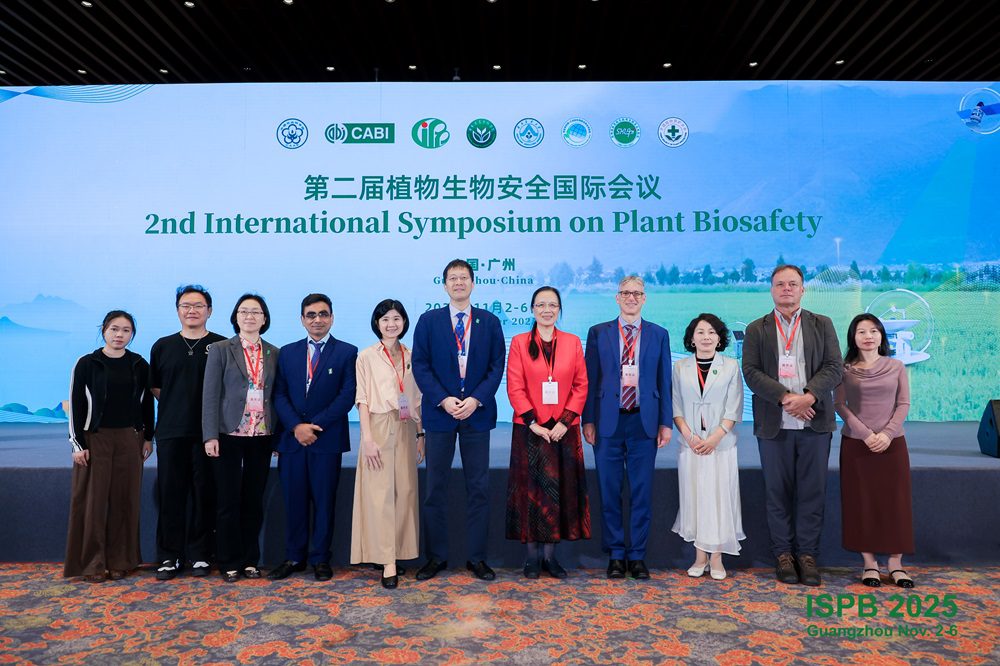 Three decades of China's membership of CABI celebrated at 2nd International Symposium on Plant Biosafety
 -
 CABI receives recognition from FAO for its work to support sustainable plant production and protection