

IPPCAAS reveals male moths release male sex pheromone to interfere with rivals’ olfactory communication
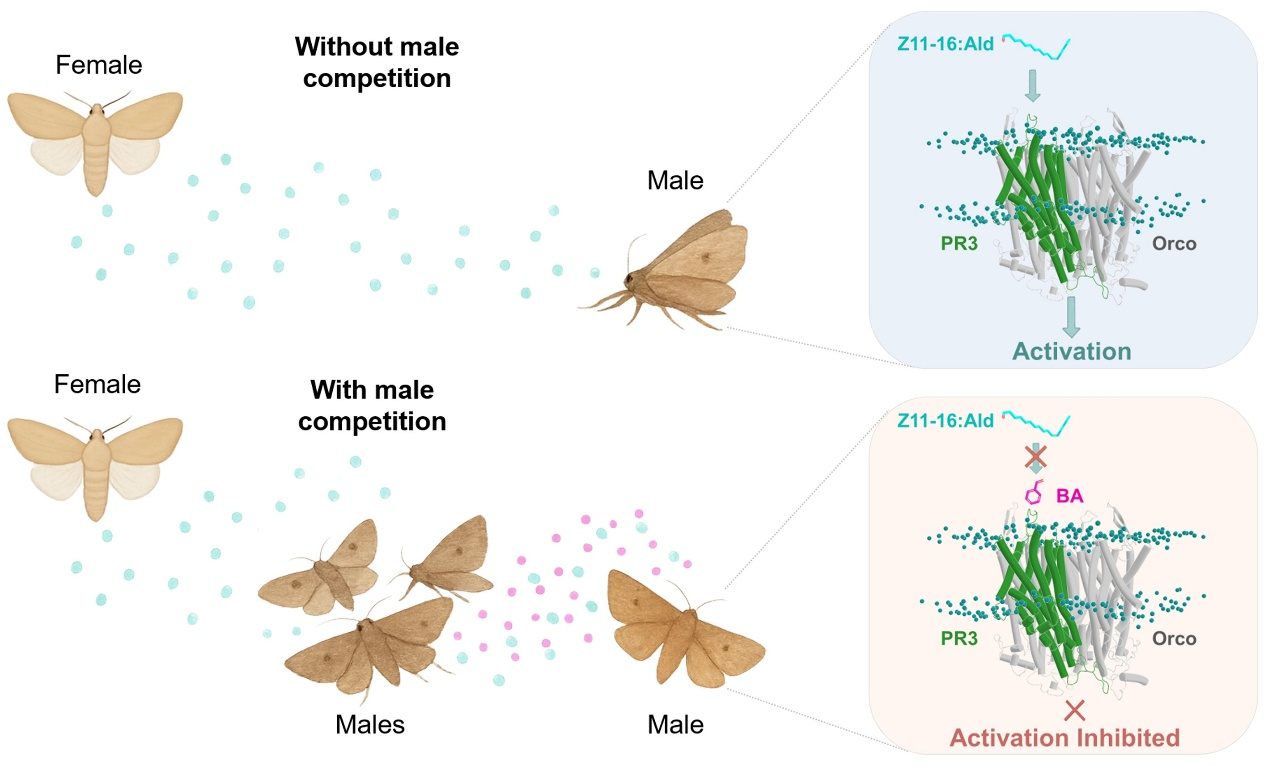
Researchers from the Innovation and Utilization of Bio-pesticides Innovation Team at the Institute of Plant Protection, Chinese Academy of Agricultural Sciences (IPPCAAS), in collaboration with the Agricultural Genomics Institute at Shenzhen and Zhejiang University, have published a paper in Proceedings of the National Academy of Sciences of the United States of America (PNAS) titled “Male-emitted benzaldehyde acts as an olfactory antagonist, disrupting moth sex pheromone communication.” The study reveals that male Mythimna separata release benzaldehyde (BA) as an olfactory antagonist during mating competition. This compound competitively inhibits the ability of rival males to detect the female sex pheromone, thereby interfering with their courtship behavior.
Male-male mating competition is a key factor influencing reproductive success in animals and represents a critical process through which sexual selection drives evolution. Chemical signals serve as important mediators of insect communication and play a vital role in regulating male competition, but their underlying mechanisms have long remained unclear. In lepidopteran insects, mating behavior is highly dependent on sex pheromone communication. Previous studies have shown that some male moths release volatile chemicals that interfere with rivals’ courtship. However, how these signals act on the olfactory system of competitors and subsequently influence their behavioral decisions has been unknown.
In this study, the researchers focused on the M. separata, a major migratory agricultural pest in China. They found that male moths significantly increased BA release under high-density mating competition conditions. Behavioral assays showed that BA did not directly repel rival males, but it significantly suppressed their orientation toward the major female sex pheromone component Z11-16:Ald, thereby impairing their ability to locate females. Further mechanistic studies revealed that BA directly inhibits the recognition of Z11-16:Ald by the female sex pheromone-specific receptor MsepPR3 at the receptor level, subsequently suppressing the activation of peripheral olfactory neurons and signal transmission in the Cu glomerulus of the antennal lobe. AlphaFold3 structural prediction and molecular dynamics simulations confirmed that BA directly competes with Z11-16:Ald for the binding sites of MsepPR3, significantly reducing the binding probability of Z11-16:Ald and ultimately interfering with female sex pheromone recognition.
Professor Wang Guirong and Professor Liu Yang, at the IPPCAAS, are co-corresponding authors of this paper. Dongdong Sun (a joint postdoctoral fellow between the Agricultural Genomics Institute at Shenzhen and IPPCAAS) and Yutong Zhang (a PhD student at the IPPCAAS) are co-first authors. PhD student Xiaoqing Wang (IPPCAAS) and Professor Yong Wang (Zhejiang University) also contributed to this research. This work was supported by the National Natural Science Foundation of China and the Agricultural Science and Technology Innovation Program.
Links: https://www.pnas.org/doi/10.1073/pnas.2600174123
-
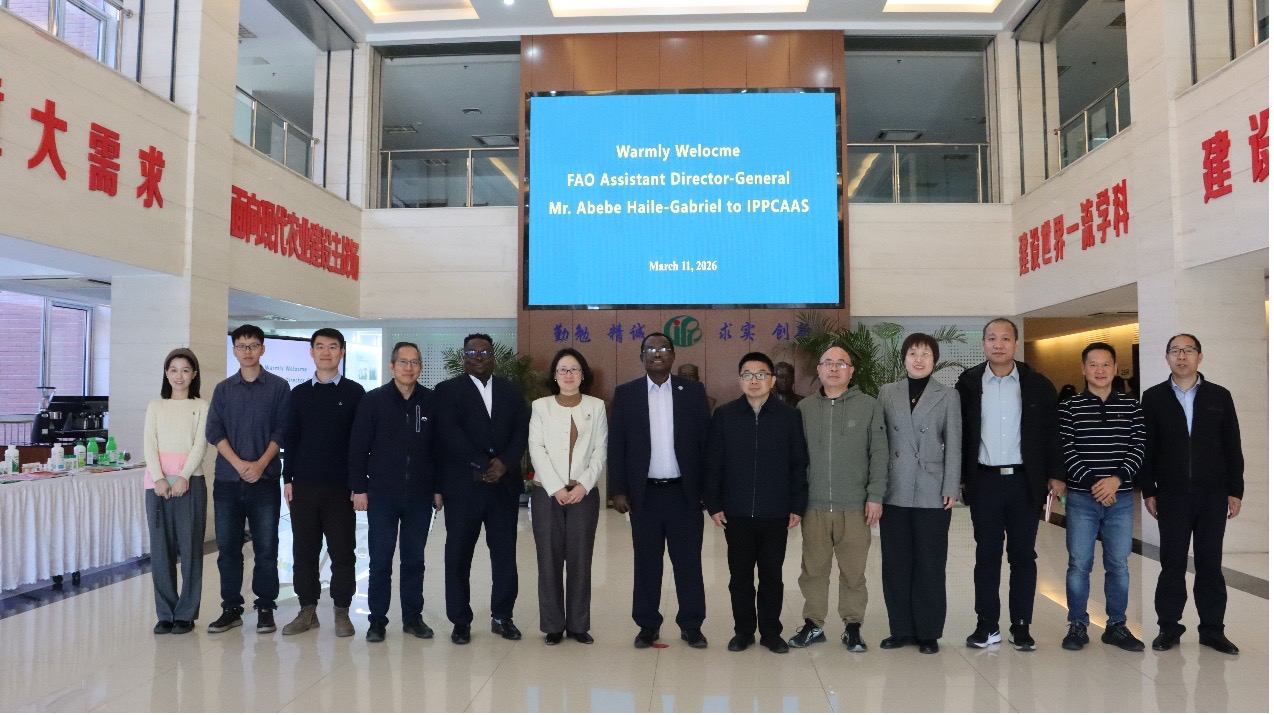 Assistant Director-General of the UN Food and Agriculture Organization Leads Delegation to Visit IPPCAAS
 -
 International Symposium on Plant Biosafety (ISPB 2025) Convenes in Guangzhou — Science-led plant health governance to secure food systems and advance the SDGs
 -
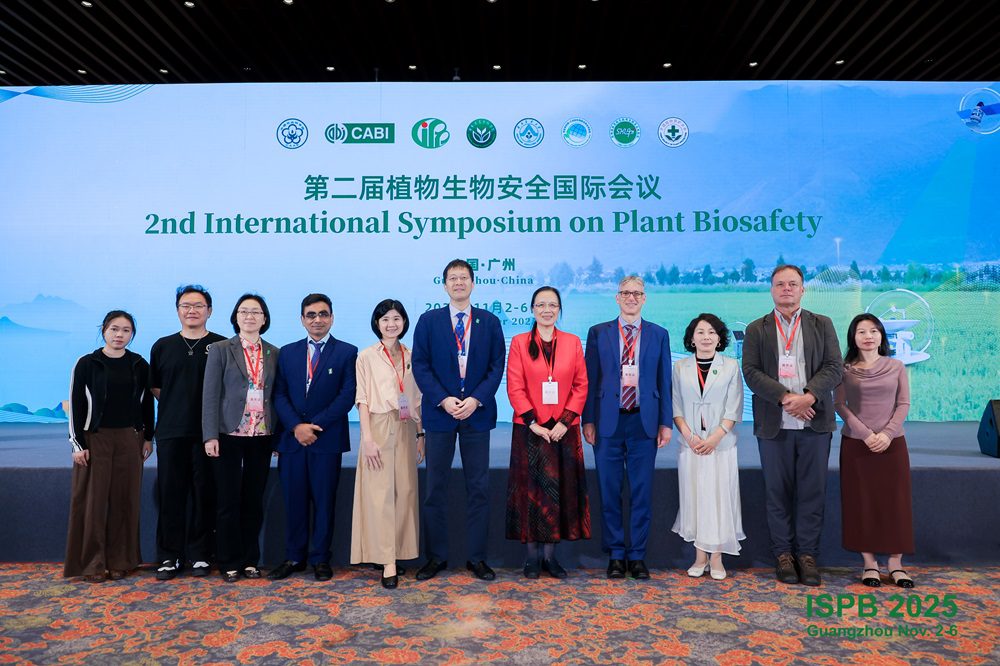 Three decades of China's membership of CABI celebrated at 2nd International Symposium on Plant Biosafety
 -
 CABI receives recognition from FAO for its work to support sustainable plant production and protection