

IPPCAAS Reveals Molecular Mechanism of Enantiomer Discrimination in Scarab Beetle Sex Pheromone Recognition
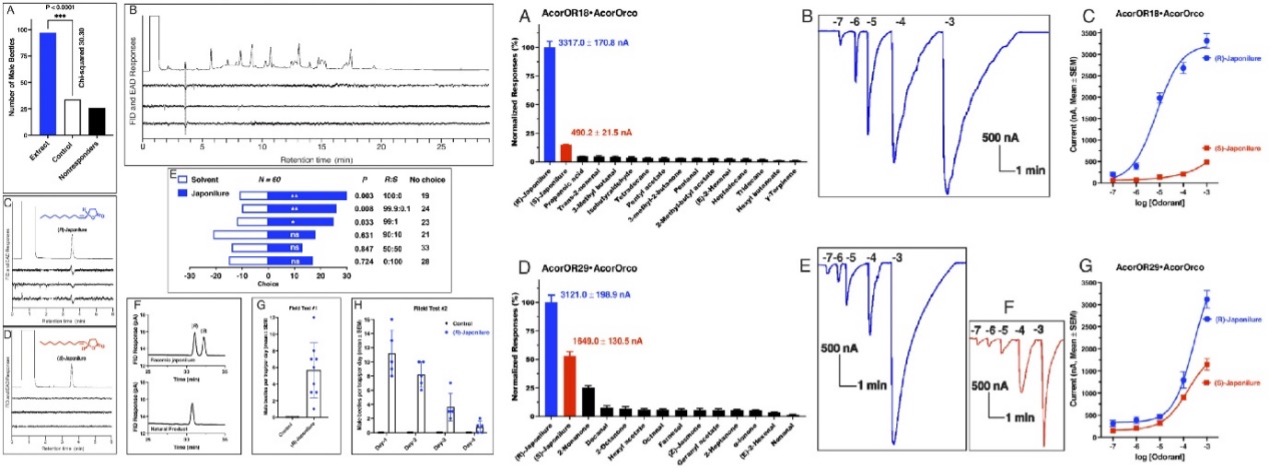
Recently, the Innovation Team for Monitoring and Control of Economic Crop Pests at the IPPCAAS, in collaboration with Northeast Normal University and the University of California, Davis, published an online research paper in the internationally renowned journal Proceedings of the National Academy of Sciences of the United States of America (PNAS), titled “Pheromone receptors for japonilure in Anomala corpulenta and Popillia japonica.” This study identified for the first time the sex pheromone of Anomala corpulenta, an important underground pest in China, and revealed the molecular mechanism by which scarab beetles, including Popillia japonica, distinguish between the sex pheromone and its chiral enantiomer (behavioral antagonist) through specific odorant receptors. The findings provide important theoretical support for developing new green pest control strategies based on pheromones and their receptor targets.
In many species of the subfamily Rutelinae (scarab beetles), several species share the same type of sex pheromone (japonilure or buibuilactone), and interspecific reproductive isolation depends on different chiral configurations of this molecule. For example, the R-configuration acts as a sex pheromone attracting conspecific individuals, while the S-configuration serves as a behavioral antagonist that inhibits heterospecific mating attraction.
The research team found that the sex pheromone of A. corpulenta is R-japonilure, and its behavioral antagonist is S-japonilure, a mechanism similar to that in P. japonica. Using the Xenopus oocyte functional expression system, the team identified that AcorOR18 and AcorOR29 are highly sensitive to R-japonilure, meanwhile AcorOR29 is also responsed to S-japonilure. Gene silencing and behavioral bioassays confirmed the key roles of these two receptors in sex pheromone recognition. Fluorescence in situ hybridization revealed that AcorOR18 and AcorOR29 are expressed in different types of antennal sensilla. Single-sensillum recordings further identified two types of sensilla in A. corpulenta antennae that are sensitive to R-japonilure: one type is activated only by R-japonilure, and the other responds to both R- and S-japonilure, corresponding to the functional characteristics of AcorOR18 and AcorOR29, respectively. To explore the conservation of the recognition mechanism in ruteline beetles, the team identified receptors orthologous to AcorOR18 and AcorOR29 in P. japonica, namely PjapOR42, PjapOR37, and PjapOR39. Functional assays showed that PjapOR42 specifically responds to R-japonilure; PjapOR37 is primarily responsive to R-japonilure; and PjapOR39 is more sensitive to S-japonilure. This study is the first to reveal the molecular framework by which scarab beetles use a pair of narrow-tuned and broadly tuned odorant receptors to cooperatively recognize the sex pheromone and its behavioral antagonist. It not only answers a key scientific question in insect chemical ecology regarding chiral recognition but also lays an important theoretical foundation for developing highly selective pheromone-based pest management technologies.
The IPPCAAS is the first affiliation of this paper. Associate Professor Wang Yinliang from Northeast Normal University, jointly trained Ph.D. student Feng Kun from IPP, and Ph.D. candidate Ke Haoqin from Northeast Normal University are the co-first authors. Professor Yin Jiao from IPP and Professor Walter Leal from the University of California, Davis are the co-corresponding authors. Researchers Li Kebin and Dong Huanhuan from IPP, Professor Ren Bingzhong from Northeast Normal University, Professor Luo Chen from Yangzhou University, and Dr. Qu Cheng and Professor Wang Ran from the Beijing Academy of Agriculture and Forestry Sciences also participated in this research. The study was supported by the National Key Research and Development Program Intergovernmental International Cooperation Project and the National Natural Science Foundation of China.
-
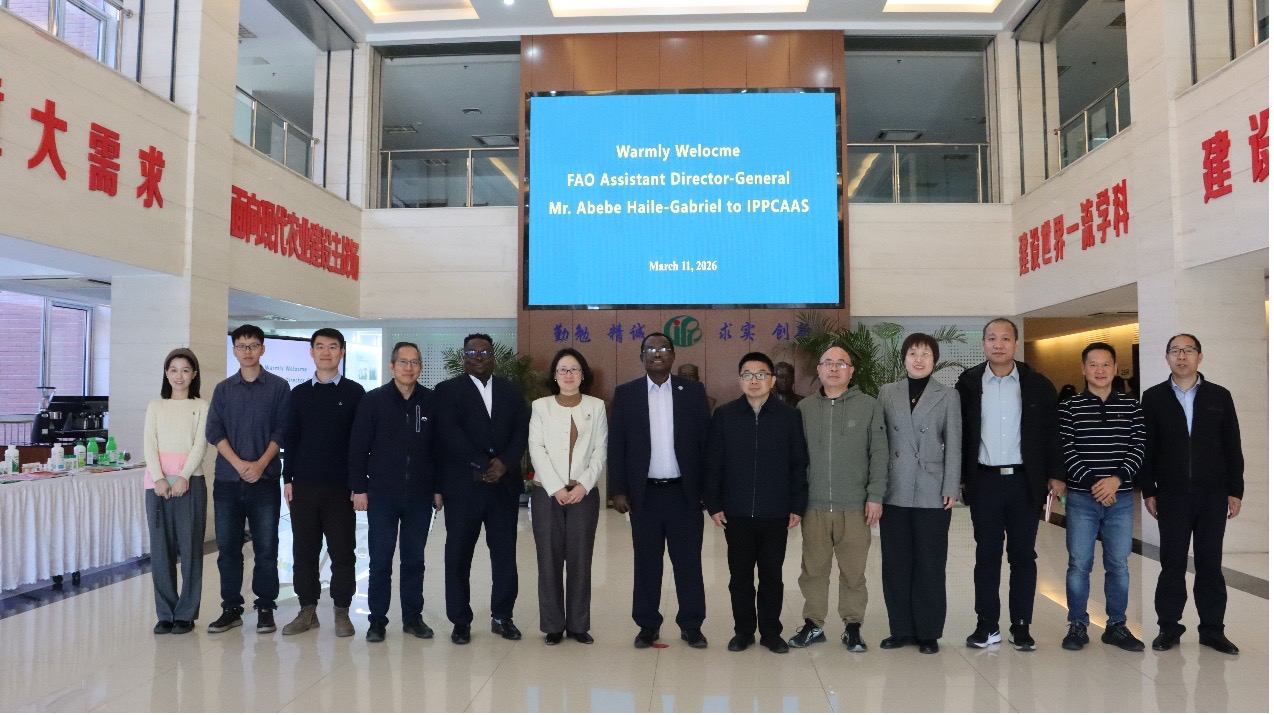 Assistant Director-General of the UN Food and Agriculture Organization Leads Delegation to Visit IPPCAAS
 -
 International Symposium on Plant Biosafety (ISPB 2025) Convenes in Guangzhou — Science-led plant health governance to secure food systems and advance the SDGs
 -
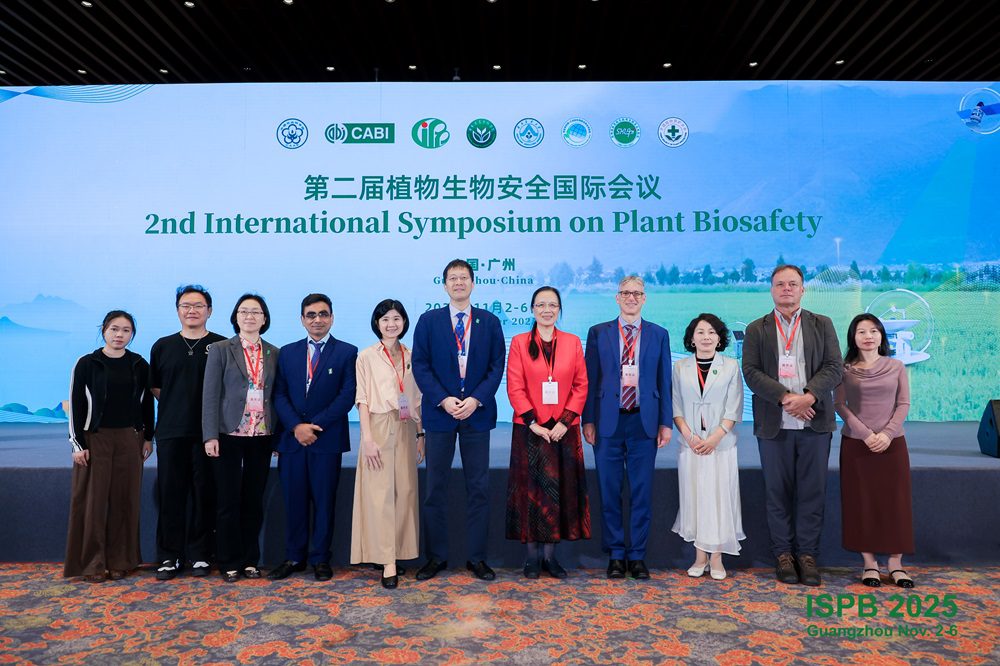 Three decades of China's membership of CABI celebrated at 2nd International Symposium on Plant Biosafety
 -
 CABI receives recognition from FAO for its work to support sustainable plant production and protection