

IPPCAAS develops rapid thiamethoxam detection technology based on PtPdRu nanozyme
Researchers from the Pesticide Application Risk Control Innovation Team at the Institute of Plant Protection, Chinese Academy of Agricultural Sciences (IPPCAAS), have published a paper in Chemical Engineering Journal (IF: 13.2) titled “PtPdRu Nanozyme Relay Catalysis: Toward a Portable and Multimode Platform for Thiamethoxam Detection”. The study successfully developed a rapid detection technology based on PtPdRu nanozyme catalysis. It enables multi‑mode detection of thiamethoxam in cowpea, including qualitative visual inspection, smartphone‑based imaging, and catalytic colorimetric quantification. This provides a new technical approach for rapid qualitative screening and quantitative detection of this insecticide.
Multifunctional signal labels play an important role in improving the sensitivity, reliability and anti‑interference ability of lateral flow immunoassays. Platinum‑group metals, with their excellent catalytic efficiency, high specific surface area and good stability, hold great promise in analytical sensing. In this study, a trimetallic (PtPdRu) nanozyme was synthesized using a one‑pot strategy. Its specific enzyme activity is 23.7 times that of monometallic Pt. The team also elucidated the relay catalytic mechanism underlying this trimetallic synergy: Ru incorporation lowers the energy barrier for hydroxyl radical (•OH) generation on the Pt surface, while Pd promotes the conversion of •OH to singlet oxygen (¹O₂), thereby accelerating the catalytic conversion of H₂O₂.
Using the pesticide thiamethoxam as the target analyte, the researchers prepared a lateral flow immunochromatographic test strip with the PtPdRu nanozyme as a signal‑tracing label. Combined with a custom‑designed smartphone‑adapted dark box for imaging, they developed a multi‑mode detection platform that enables qualitative visual inspection, smartphone‑based imaging and catalytic colorimetric quantification. The technology shows a detection sensitivity of 0.03-5 ng/mL for thiamethoxam, with recovery rates ranging from 91.5 % to 103.8 % and relative standard deviations (RSD) of 0.8 %-10.0 %. The platform has been applied to detect thiamethoxam residues in 90 cowpea samples from 21 cities across China, yielding results consistent with national standard methods. This research not only provides a reference for the rational design of platinum‑group nanozymes but also offers a portable and reliable new solution for on‑site rapid screening of pesticide residues in agricultural products.
Zhang Binbin (PhD student) is first author, and Professor Pan Xinglu is corresponding author. Master’s students Zhang Wentao, Pu Zhuoying and Cui Junwei contributed to parts of the research. This work was supported by the National Natural Science Foundation of China (grant no. 32272601) and the Innovation Program of the Chinese Academy of Agricultural Sciences.
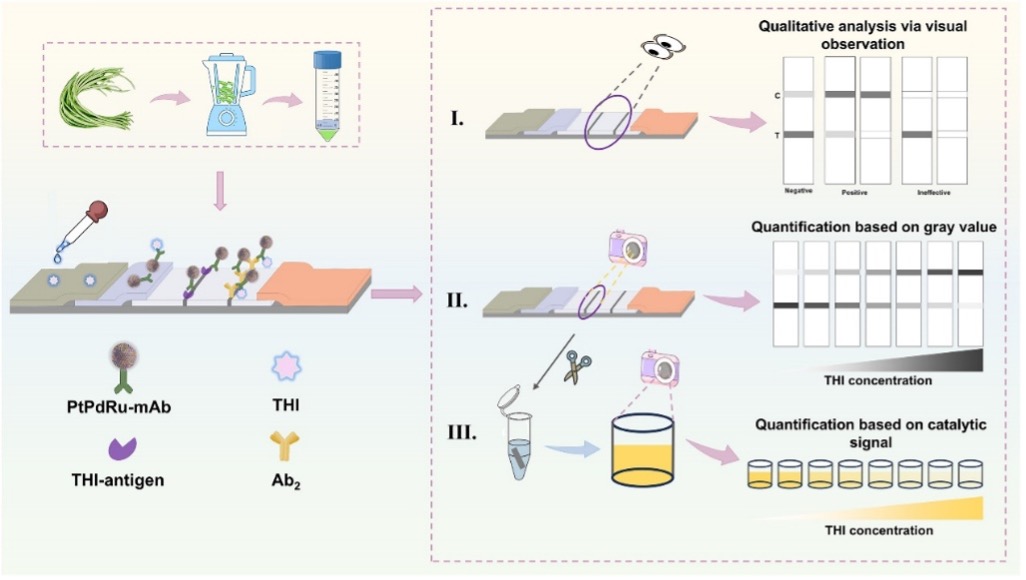
Link: https://doi.org/10.1016/j.cej.2026.174821
-
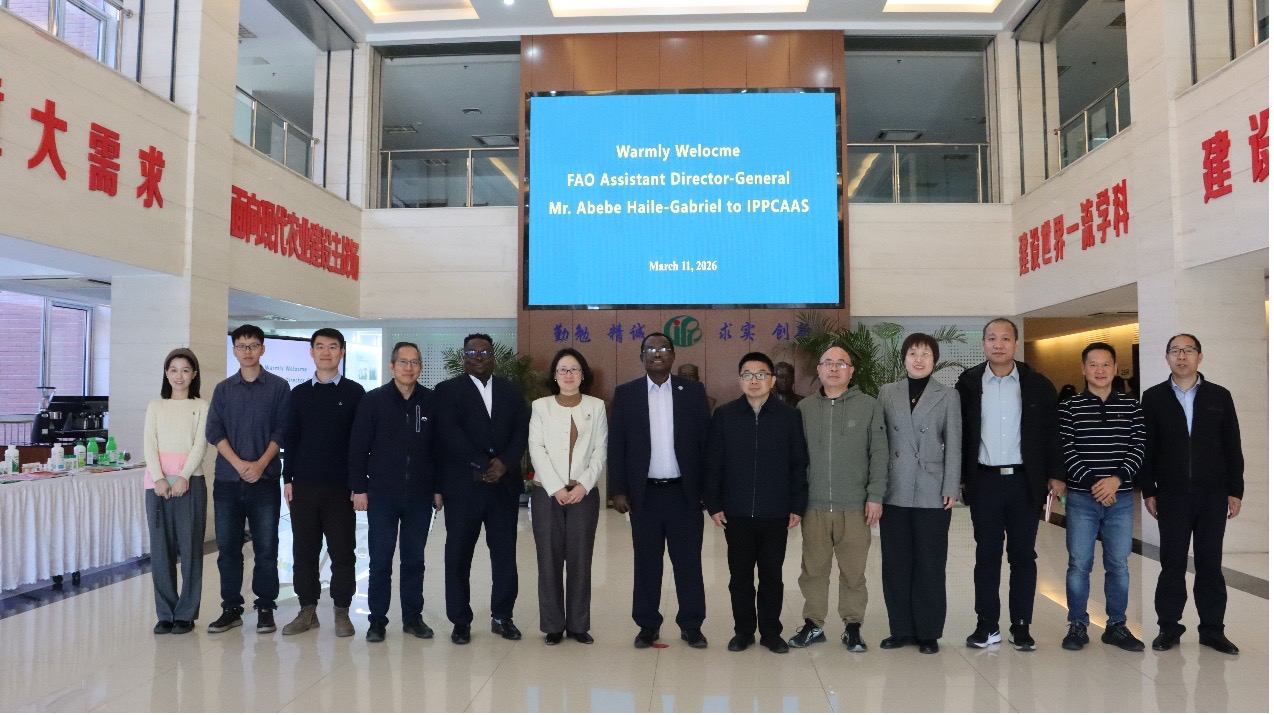 Assistant Director-General of the UN Food and Agriculture Organization Leads Delegation to Visit IPPCAAS
 -
 International Symposium on Plant Biosafety (ISPB 2025) Convenes in Guangzhou — Science-led plant health governance to secure food systems and advance the SDGs
 -
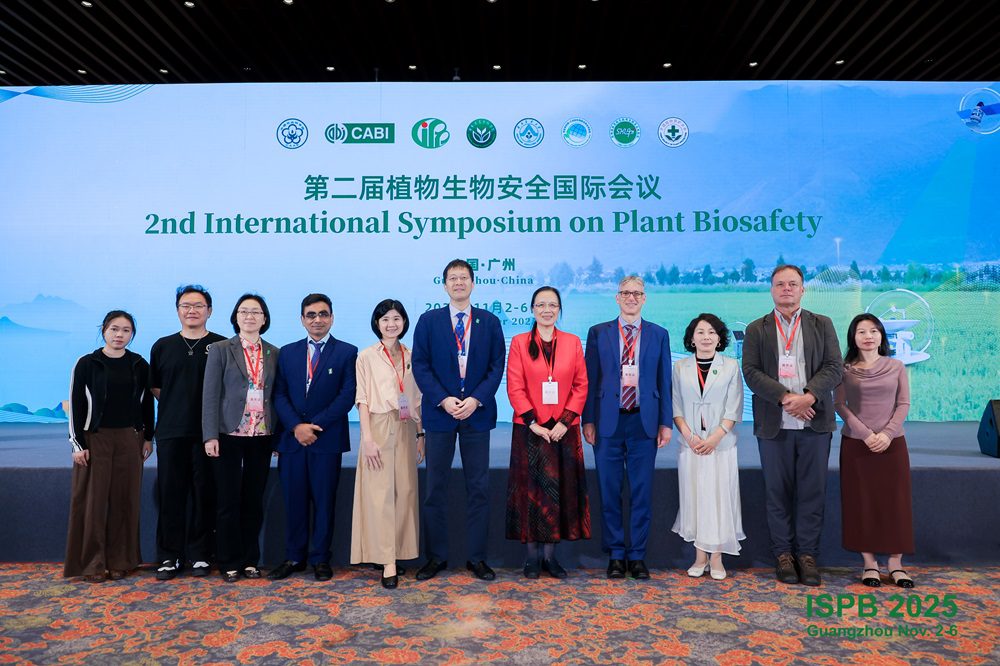 Three decades of China's membership of CABI celebrated at 2nd International Symposium on Plant Biosafety
 -
 CABI receives recognition from FAO for its work to support sustainable plant production and protection