

IPPCAAS Collaboration Reveals Novel Mechanism of Plant Broad-Spectrum Antiviral Defense
Recently, the Innovation Team for Monitoring and Control of Crop Viral Diseases at the IPPCAAS, in collaboration with Henan Agricultural University, published an online research paper in the journal of Plant Biotechnology Journal, titled “Methionine synthase positively regulates plant defense to both RNA and DNA viruses and is useful for developing broad-spectrum antiviral resistance in crops.” This study reveals that plant methionine synthase (MS) positively regulates the host antiviral defense by interacting with viral suppressors of gene silencing (VSR) proteins from various RNA and DNA viruses and thus inhibiting their activity. These findings broaden our understanding of host-virus interaction mechanisms, and provide a potential target gene for future breeding of elite crop germplasm with broad-spectrum virus resistance through manipulation of the methionine synthase gene expression.
Viruses are major biotic stresses causing significant losses in crop yield and quality. Due to factors such as the diversity of virus species, rapid mutation rates, and the lack of efficient and broad-spectrum control measures, viral disease outbreaks often lead to substantial economic losses. During the long-term co-evolution between viruses and plants, host cells have developed various defense mechanisms to prevent viral infection or limit excessive viral proliferation. The discovery of antiviral functional genes and in-depth study of their function not only enhance the understanding of plant–virus interaction mechanisms but also provide theoretical foundations and genetic resources for improving crop virus resistance.
In this study, through screening the host proteins that interact with the VSR protein (17K) encoded by barley yellow dwarf viruse-GAV (BYDV-GAV), the researchers identified a barley gene encoding methionine synthase (MS1), which is conserved in higher plants. Using multiple protein interaction assays, they confirmed that 17K interacts with both MS1 and MS2 in the host barley. By generating MS gene-edited mutants and overexpression lines in wheat, they found that MS positively regulates wheat resistance to BYDV-GAV. Moreover, overexpression of MS also enhanced wheat resistance to BSMV (barley stripe mosaic virus), suggesting that MS possesses broad-spectrum antiviral activity. Further experiments showed that overexpression of MS in tobacco significantly enhanced resistance to multiple RNA and DNA viruses. Mechanistic studies revealed that VSR proteins encoded by various RNA and DNA viruses can interact with MS, suggesting that the broad-spectrum antiviral function of MS may result from impairing VSR activity through these protein-protein interactions. This study uncovers a novel mechanism by which plants positively regulate host antiviral defense through the key metabolic enzyme MS.
Researchers Jin Huaibing from the IPPCAA, Wang Daowen and You Liyuan from Henan Agricultural University are the co-corresponding authors of this paper. The study was supported by multiple grants, including the National Natural Science Foundation of China.
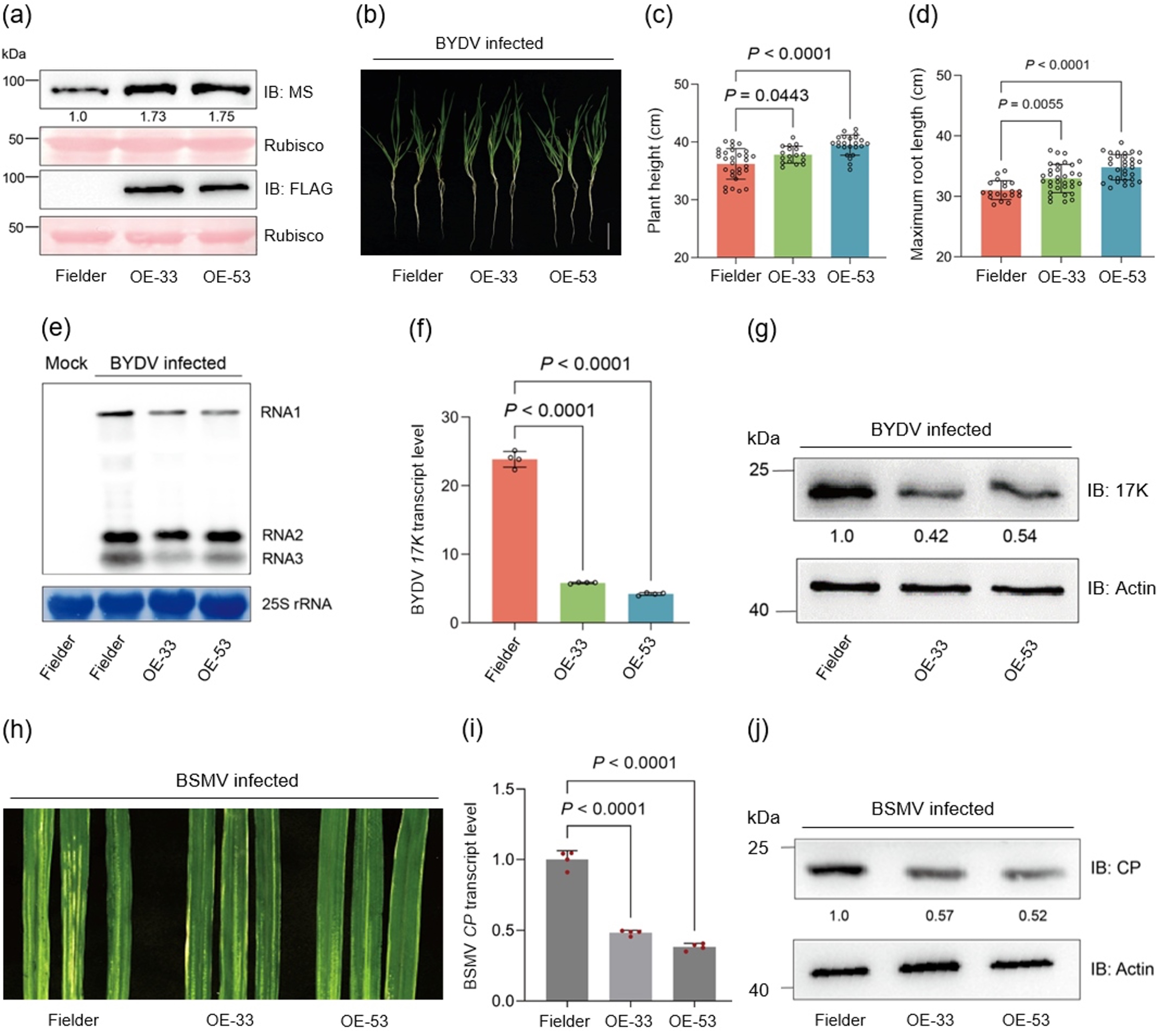
Figure: Resistance analysis of MS1-overexpressing wheat to BYDV-GAV and BSMV
Link:https://onlinelibrary.wiley.com/doi/10.1111/pbi.70618
-
 Assistant Director-General of the UN Food and Agriculture Organization Leads Delegation to Visit IPPCAAS
 -
 International Symposium on Plant Biosafety (ISPB 2025) Convenes in Guangzhou — Science-led plant health governance to secure food systems and advance the SDGs
 -
 Three decades of China's membership of CABI celebrated at 2nd International Symposium on Plant Biosafety
 -
 CABI receives recognition from FAO for its work to support sustainable plant production and protection