

IPP Reveals a Novel Mechanism for Enhancing Rice Disease Resistance by Pyramiding Key Basal Immunity Gene and Resistance Gene
Recently,the Crop Pathogen Functional Genomics Research Innovation Team at the Institute of Plant Protection (IPP), Chinese Academy of Agricultural Sciences (CAAS), published an online research paper titled “Pyramiding basal immunity and effector-triggered immunity to achieve broad-spectrum disease resistance in rice” in Science Bulletin. This study firstly pyramided key basal immunity gene and resistance gene in plants to develop new broad-spectrum disease-resistant rice materials, providing new insights for molecular breeding of crop disease resistance.
Plant basal immune responses confer broad-spectrum but relatively weak resistance against multiple pathogens. In contrast, effector-triggered immunity mediated by resistance genes provides complete resistance, but only against specific pathogen races. Overexpression of NPR1, a core positive regulator of basal immunity, can achieve broad-spectrum resistance in plants but accompanied by plant growth inhibition and yield reduction. The rice blast resistance gene Piz-tconfers complete resistance to Magnaporthe oryzae isolates harboring the avirulence gene AvrPiz-t, but cannot recognize other M. oryzae isolates or pathogens.
The study found that Piz-t interacts with OsNPR1. Knockout of OsNPR1 impairs basal immunity but does not disrupt Piz-t-mediated resistance. The OsNPR1 overexpression (OsNPR1OE) lines crossed rice plants carrying Piz-t, resulting in a new pyramiding rice material (Piz-t × OsNPR1OE). This new material not only retains Piz-t-mediated resistance to incompatible M. oryzae, but also significantly enhances resistance to compatible M. oryzae isolates and Xanthomonas oryzae pv. oryzae (Xoo), the causal agent of bacterial blight. Interestingly, Piz-t promotes the dimerization of OsNPR1, leading to partial alleviation of the growth defects caused by OsNPR1 overexpression. The study further identified the dimerization sites of OsNPR1 and confirmed that OsNPR1 dimerization is a key factor balancing disease resistance and plant growth. Based on these findings, the team overexpressed OsNPR1 in the breeding line 07GY31-Piz-t, creating a new rice germplasm with both broad-spectrum disease resistance and uncompromised growth. This study not only provides a new strategy for the application of NPR1 genes in disease-resistant breeding but also serves as a paradigm for resistance improvement through the pyramiding of basal immunity gene and R gene.
Dr. Feng He, a jointly trained postdoctoral fellow from IPP CAAS and Agricultural Genomics Institute at Shenzhen, is the first author of the paper. Professor Yuese Ning from IPPCAAS is the corresponding author. The study was supported by projects including the National Key Research and Development Program of China, the Science and Technology Innovation Project of CAAS, the National Natural Science Foundation of China, and the China Postdoctoral Science Foundation.
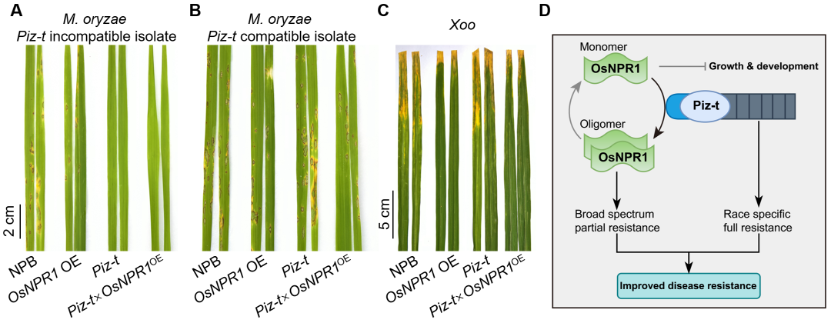
Figure. Pyramiding R Gene Piz-t and Key Basal Immunity Gene OsNPR1 Enhances Broad-Spectrum Resistance in Rice
Link: https://www.sciencedirect.com/science/article/pii/S2095927325013210
-
 Assistant Director-General of the UN Food and Agriculture Organization Leads Delegation to Visit IPPCAAS
 -
 International Symposium on Plant Biosafety (ISPB 2025) Convenes in Guangzhou — Science-led plant health governance to secure food systems and advance the SDGs
 -
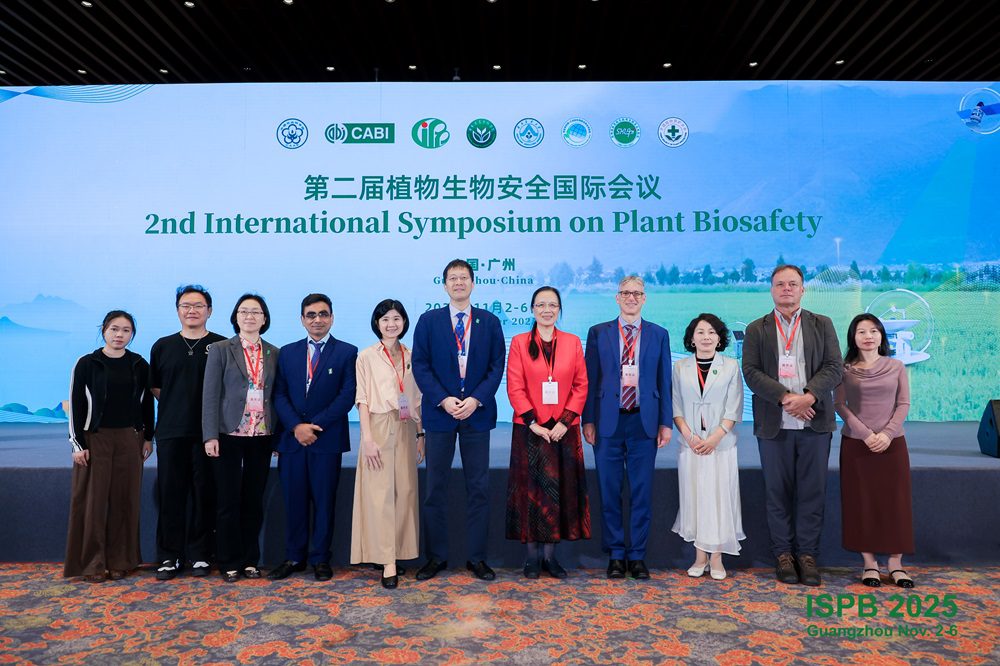 Three decades of China's membership of CABI celebrated at 2nd International Symposium on Plant Biosafety
 -
 CABI receives recognition from FAO for its work to support sustainable plant production and protection