

IPPCAAS Breaks Through Bottleneck in Bt Insecticidal Protein Development, Ancestral Sequence Reconstruction Opens New Path for Green Pest Control
Recently, the Innovation Team for Research and Utilization of Insect-Resistant Functional Genes at the IPPCAAS, in collaboration with Anhui Agricultural University, achieved a breakthrough in the field of Bacillus thuringiensis (Bt) insecticidal proteins. The related research findings were published in the internationally renowned academic journal Science Bulletin (Impact Factor: 21.1) under the title “Resurrecting the past: Ancestral Bacillus thuringiensis pesticidal proteins reveal broad-spectrum insecticidal activity and protein engineering hotspots.” This study employed ancestral sequence reconstruction (ASR) technology to trace the evolutionary history of Bt insecticidal protein activity, identify highly effective insecticidal proteins and key functional sites, and successfully design novel, efficient, broad-spectrum insecticidal proteins, providing a new paradigm for research in this field (Figure 1).
Bt insecticidal proteins, known for their specific targeted insecticidal properties, are a key technological support for green pest control in agriculture. However, long-term and single-minded use can easily lead to resistance in target pests, constraining sustainable agricultural development. There is an urgent need to discover novel, efficient, broad-spectrum Bt insecticidal proteins that lack cross-resistance with the widely used Cry1Ab and Cry1Ac proteins. Over the past several decades, neither natural strain screening nor protein engineering has yielded novel insecticidal proteins comparable to Cry1Ab and Cry1Ac, creating a bottleneck in the industry.
According to the joint team, this study systematically applied ASR technology to the development of Bt insecticidal proteins for the first time (Figure 2). Focusing on the Cry2A protein family, which lacks cross-resistance with Cry1A proteins, the team systematically traced the evolutionary history of the Cry2A family, successfully reconstructed seven ancestral genes, and achieved soluble expression in Escherichia coli. Bioactivity assay results showed a groundbreaking breakthrough: the “resurrected” ancestral proteins (especially Anc0) exhibited excellent broad-spectrum insecticidal activity against all nine tested lepidopteran pests (covering the families Noctuidae, Geometridae, and Pyralidae) as well as the dipteran Aedes albopictus. In contrast, modern Cry2A toxins (e.g., Cry2Ae, Cry2Ah) are effective against only 3–5 lepidopteran species, showing a significantly narrower host range. This discovery challenges the conventional notion that “modern proteins are functionally superior to ancestral proteins,” revealing that ancestral proteins represent an untapped “broad-spectrum insecticidal protein resource library.” Of even greater scientific value is the team’s first discovery that Cry2A proteins exhibit a “fluctuating evolution” model: by analyzing the changes in Cry2A toxin efficacy over evolutionary time, they found that toxicity against key agricultural pests such as Noctuidae and Geometridae did not increase linearly but showed non-linear fluctuations of “high efficiency – low efficiency – high efficiency again.” Further data analysis suggests that this fluctuation may arise from the protein acquiring different target sites for the same pest species during evolution. This core finding provides a disruptive approach to modern pest resistance management—namely, by tracing the target diversity of ancestral proteins, designing novel insecticidal proteins with different recognition sites, and solving the problem of pest resistance in Bt protein application through recognition module replacement.
Professor Shu Changlong from the IPPCAAS is the corresponding author of this paper. Lecturer Wang Kui from Anhui Agricultural University is the first author. Researchers Zhang Jie, Cao Haiqun, Liao Min, Cao Beibei, and Professor Ben Raymond from the University of Exeter participated in this work. The study was supported by the National Natural Science Foundation of China (Grant No. 32102295).
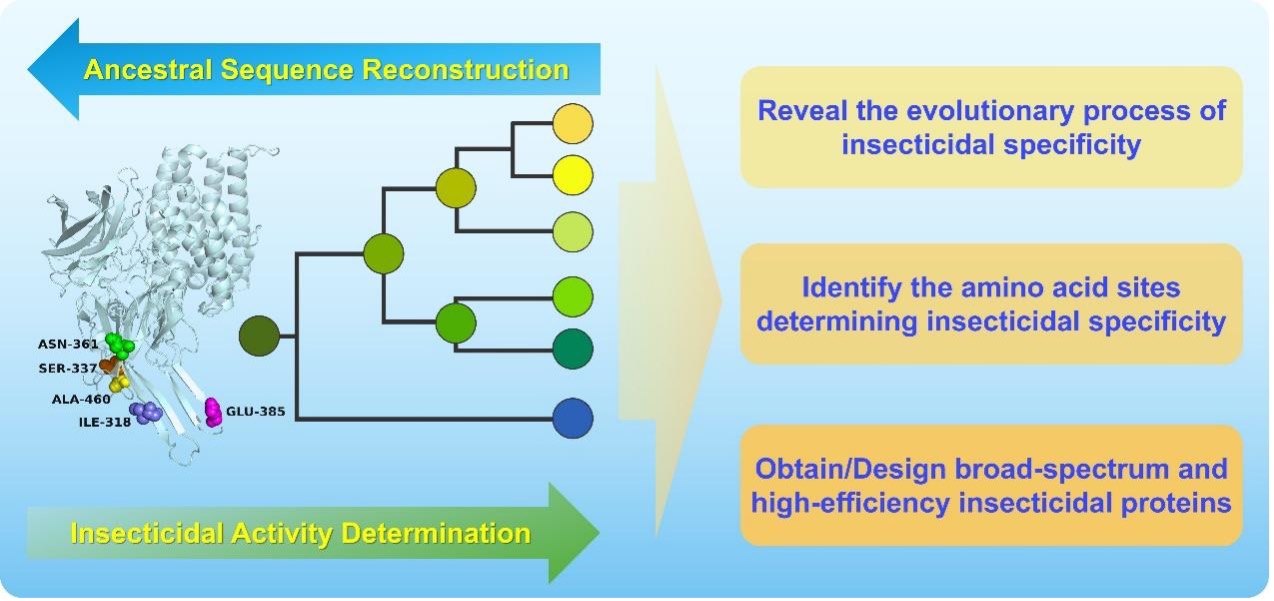
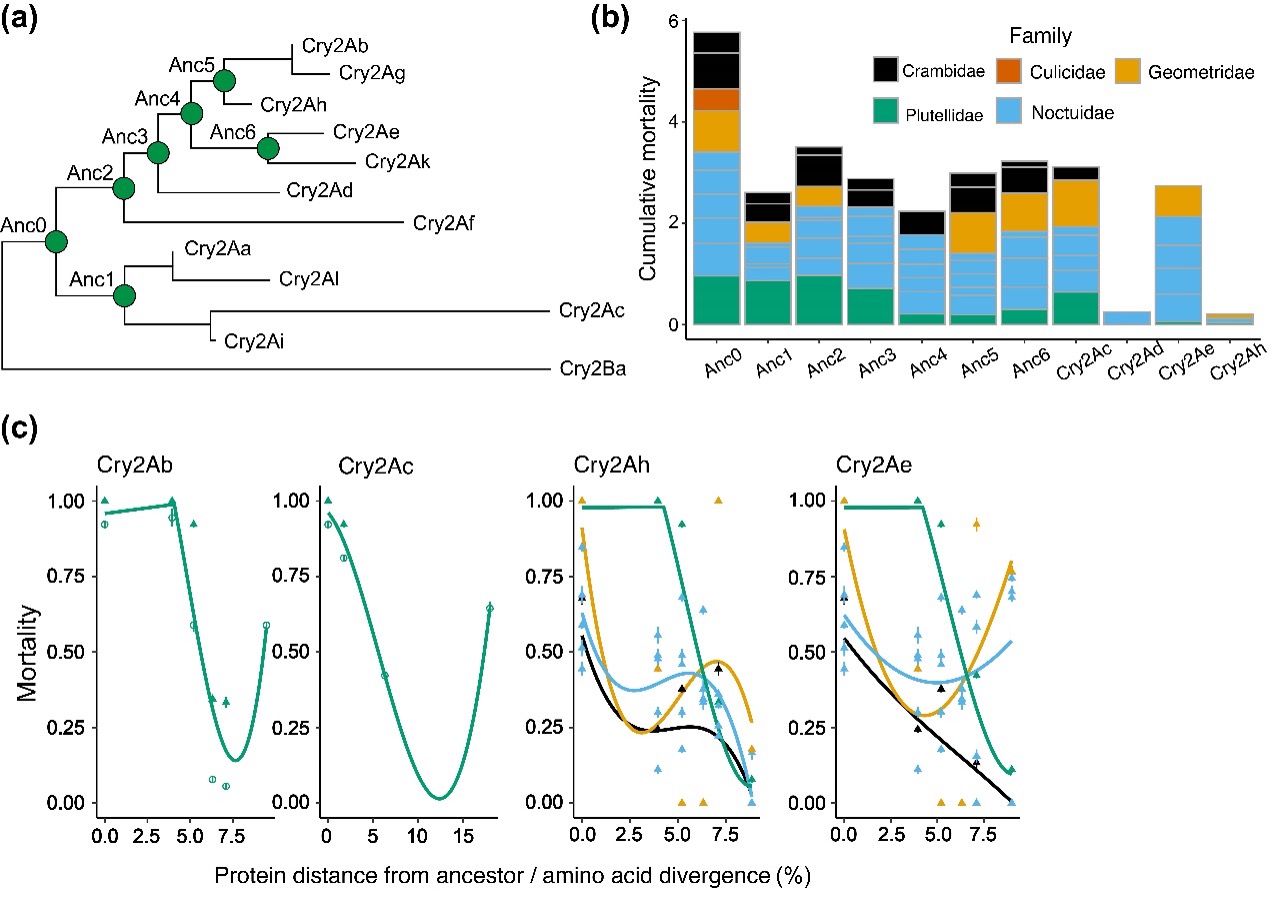
Figure 2 (a) Ancestral sequence reconstruction of Cry2A: Anc0–Anc6 are reconstructed ancestral proteins; (b) Insecticidal spectra of ancestral and contemporary proteins; (c) Evolutionary trend of insecticidal activity of Cry2A proteins: Cry2Ab and Cry2Ac against Plutella xylostella, and Cry2Ah and Cry2Ae against Noctuidae and Geometridae, both exhibit a fluctuating evolutionary pattern over evolutionary time.
Link: https://doi.org/10.1016/j.scib.2025.09.018
-
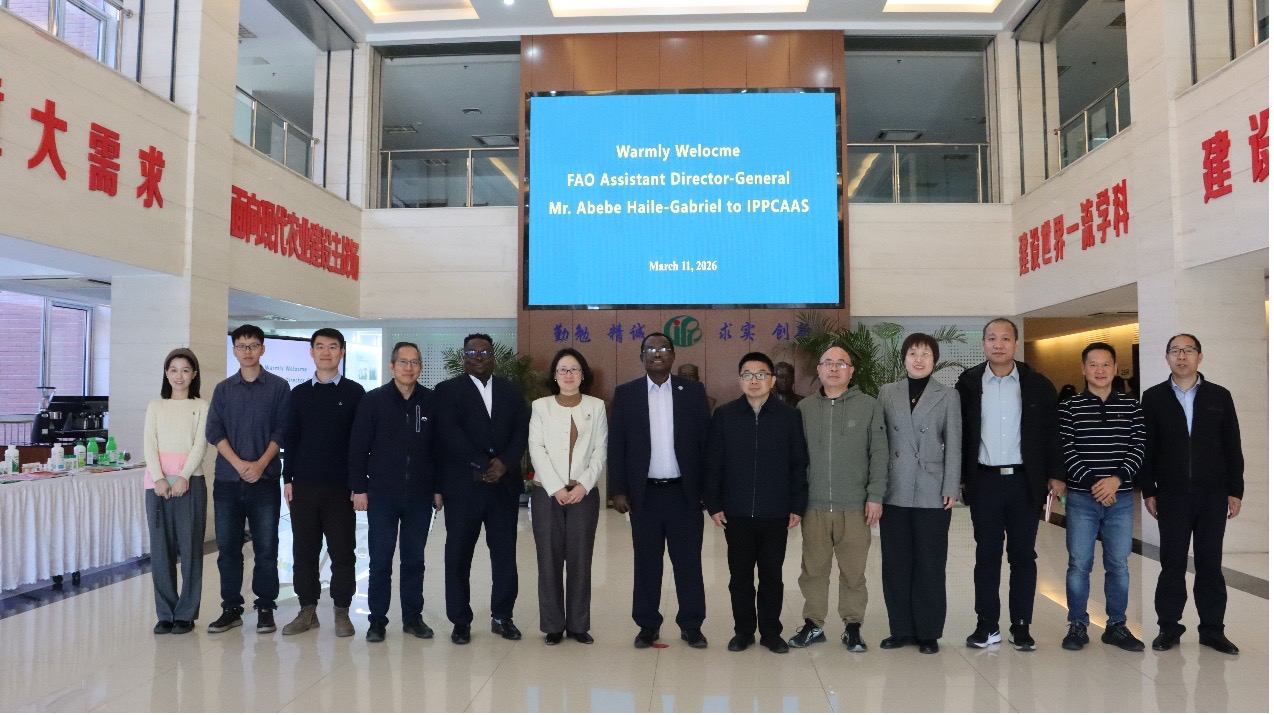 Assistant Director-General of the UN Food and Agriculture Organization Leads Delegation to Visit IPPCAAS
 -
 International Symposium on Plant Biosafety (ISPB 2025) Convenes in Guangzhou — Science-led plant health governance to secure food systems and advance the SDGs
 -
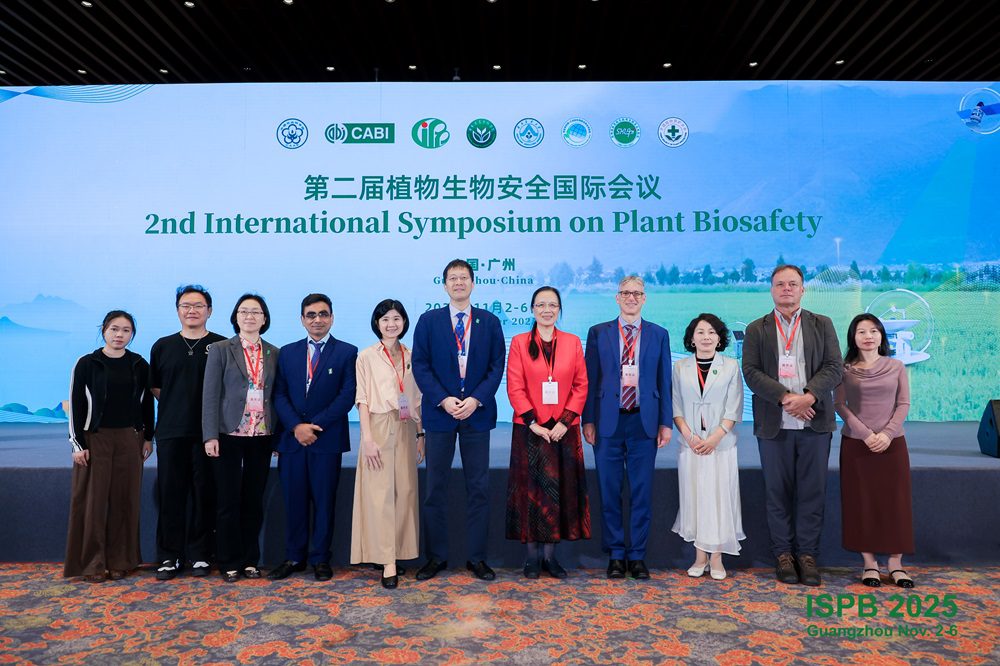 Three decades of China's membership of CABI celebrated at 2nd International Symposium on Plant Biosafety
 -
 CABI receives recognition from FAO for its work to support sustainable plant production and protection