

IPPCAAS Successfully Unveils the Invasion Spread Patterns and Climatic Niche Dynamics of the Tomato Leaf Miner Tuta absolutain China
Recently, the Agricultural Invasive Species Prevention and Monitoring Innovation Team at IPPCAAS published a research article entitled "Modeling the spread patterns and climatic niche dynamics of the tomato leaf miner Tuta absoluta following its invasion of China" in the international entomological journal Journal of Pest Science. Based on six years of systematic nationwide monitoring data, the study elucidates the spread patterns and adaptive changes in the climatic niche of T. absoluta in China, providing crucial scientific support for the development of targeted biosecurity measures and dynamic management strategies.
Tuta absoluta is a globally invasive pest that poses a severe threat to solanaceous crops such as tomatoes and can cause yield loss of up to 80–100% in severe cases. Since its initial detection in Xinjiang in 2017 and in Yunnan in 2018, the pest has rapidly spread to more than 20 provinces across China, posing a serious challenge to the sustainable production of tomatoes and other solanaceous crops. However, its specific dispersal routes in China and its adaptive changes to the new environment have remained unclear.
Using six years of national monitoring data, the study reconstructed the invasion and dispersal pathways of T. absoluta in China using the Minimum Cost Arborescence (MCA) approach. The results show that the species exhibits a "dual-source invasion" pattern, originating from Xinjiang and Yunnan, respectively. The Yunnan population further diverged into two main dispersal routes: a southern route spreading toward eastern coastal regions and a northern route extending northward to Northeast China. In contrast, the dispersal of the Xinjiang population has remained largely confined to northwestern China. Overall, the pest demonstrated an extremely high dispersal capacity, with a median spread rate of 1,098.79 meters per day. Comparisons between observed dispersal route lengths and randomized simulations indicate the presence of significant long-distance dispersal events, which are most likely associated with human activities—especially the commercial trade and transport of infested tomato fruits and seedlings, as well as their packaging materials and transport vehicles.
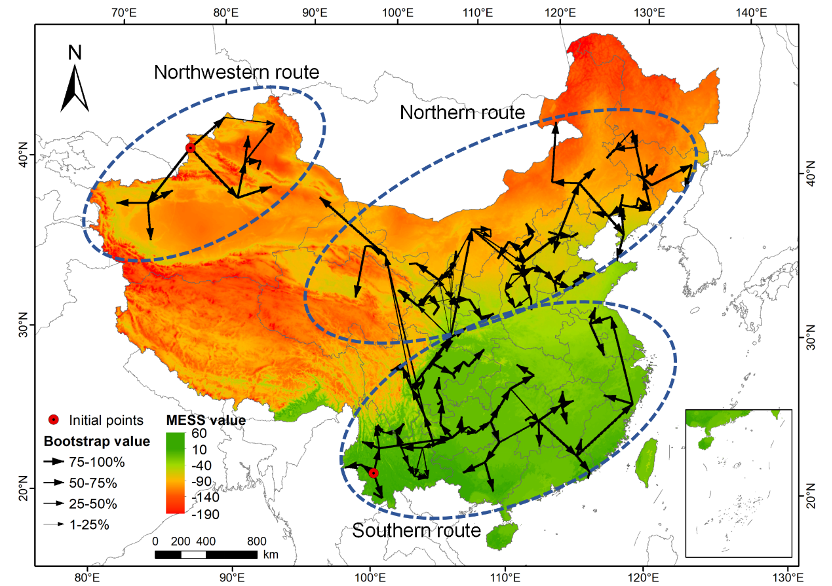
Figure 1. Dispersal Corridors Reconstruction of Tuta absoluta in China
Furthermore, by comparing climatic niches of populations from the native range (South America) and invaded regions outside and within China, the study employed the COUE framework (Centroid shift, Overlap, Unfilling, Expansion) to quantify changes in the species' climatic niche. The results reveal a significant niche expansion during the invasion of China. Compared with populations in the native range and in earlier invaded regions, Chinese populations exhibit broader tolerance to temperature and precipitation conditions. This suggests that the pest is adapting to relatively colder and drier climatic zones in China, which helps explain its continued spread into northern temperate regions.
-
 Assistant Director-General of the UN Food and Agriculture Organization Leads Delegation to Visit IPPCAAS
 -
 International Symposium on Plant Biosafety (ISPB 2025) Convenes in Guangzhou — Science-led plant health governance to secure food systems and advance the SDGs
 -
 Three decades of China's membership of CABI celebrated at 2nd International Symposium on Plant Biosafety
 -
 CABI receives recognition from FAO for its work to support sustainable plant production and protection