
IPPCAAS proposes a new paradigm framework of “ecological precision surgery” for biological invasion management
Recently, the Innovation Team for prevention and control of agricultural invasive species at the Institute of Plant Protection, Chinese Academy of Agricultural Sciences (IPPCAAS), published a paper in Ecological Indicators (IF = 7.4; CAS Q1, Top) entitled “Advancing ecological precision surgery through a paradigm framework targeted for invasion risk management.” The study for the first time establishes a multi-node, whole-stage, and cross-scale risk-management framework for invasive species—covering invasion-trait determination, colonization and spread risk assessment, and prioritization of management areas—and innovatively introduces the concept of “ecological precision surgery.” Using invasive Xanthium spp. as a targeted case, the authors resolved invasion-advantage traits based on functional characteristics and genotypic features, identified cross-border introduction sources, colonization-risk regions, and key dispersal corridors, and defined risk-priority management tiers across regional and micro-functional landscape scales. The work provides guidance for risk prevention and precision management of Xanthium invasions in China and further supports the construction of an “early warning–early detection–early response” control system for biological invasions.
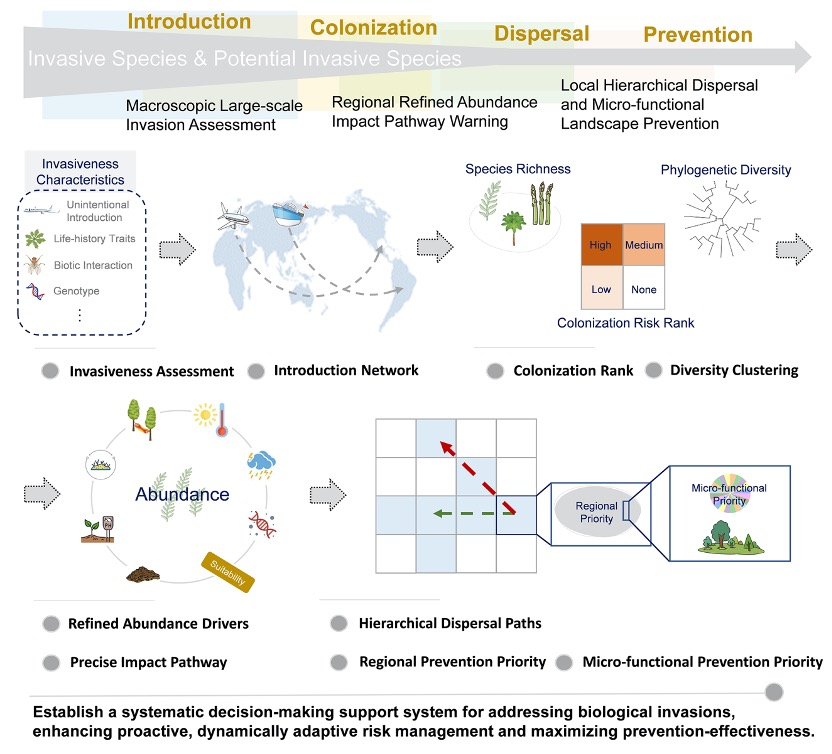
Paradigm framework for invasive-species risk management enabling multi-node, whole-stage, cross-scale assessment and refined prevention.
The results show that intrinsic functional traits, resource availability, economic uses, and propagule pressure act in concert to shape the invasion advantages of alien Xanthium species. In China, colonization-risk regions are concentrated in North China, East China, Central China, and Southwest China; densely populated regions with well-developed trade and transport—such as East and North China—constitute high-risk dispersal corridors. By establishing risk-priority management tiers at both regional and micro-functional landscape scales, the study pinpoints higher-priority areas in parts of North, East, and South China, and highlights landscape types such as cropland, urban areas, and temperate forests as higher-priority management targets. It further reveals that, under climate and land-use change, northern China faces increasing invasion risk.
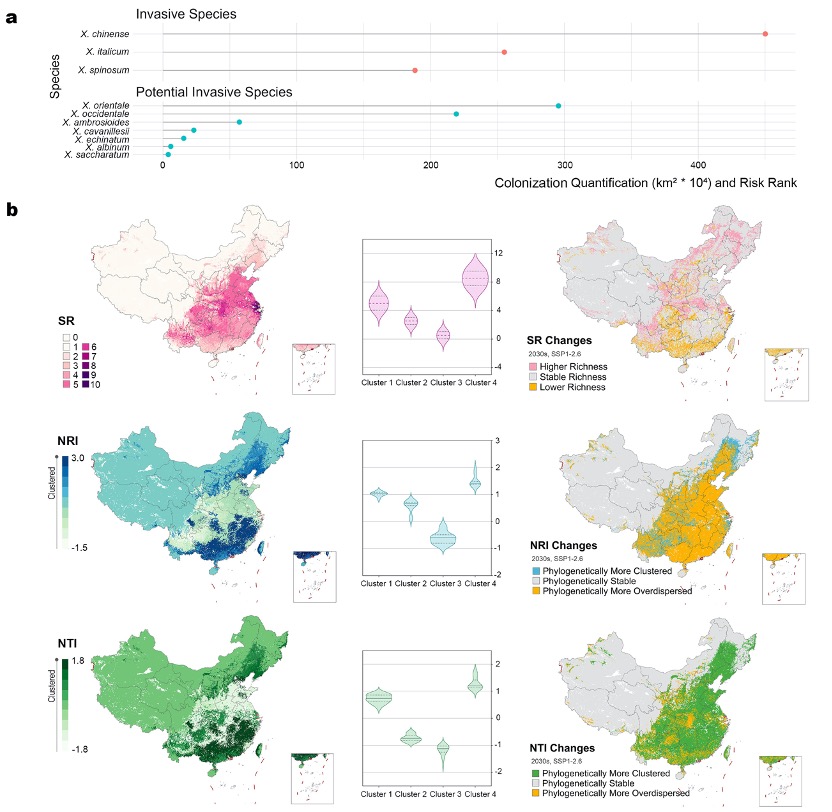
Colonization risk of invasive Xanthium spp. and clustering of species and phylogenetic diversity.
Qi Yuhan, doctoral candidate at IPPCAAS, is the first author; Liu Wanxue, Professor at IPPCAAS, is the corresponding author. Prof. Frédéric Francis and Assoc. Prof. Rudy Caparros Megido (University of Liège), and IPPCAAS Professors Wan Fanghao and Yang Nianwan, Associate Professor Xian Xiaoqing, Dr. Zhao Haoxiang, and Ph.D. candidate Yang Ming provided guidance and support. Huang Hongkun (Researcher) and Zhang Chi (Associate Researcher) from MARA’s National Agro-ecology and Resource Protection Station, Prof. Feng Yulong (Shenyang Agricultural University), and Assoc. Prof. Dong Hegan (Shihezi University) also contributed guidance. The research was supported by the National Key R&D Program of China (2024YFC2607600; 2023YFC2605200) and the CAAS Science and Technology Innovation Program (CAAS-ZDRW202505).
-
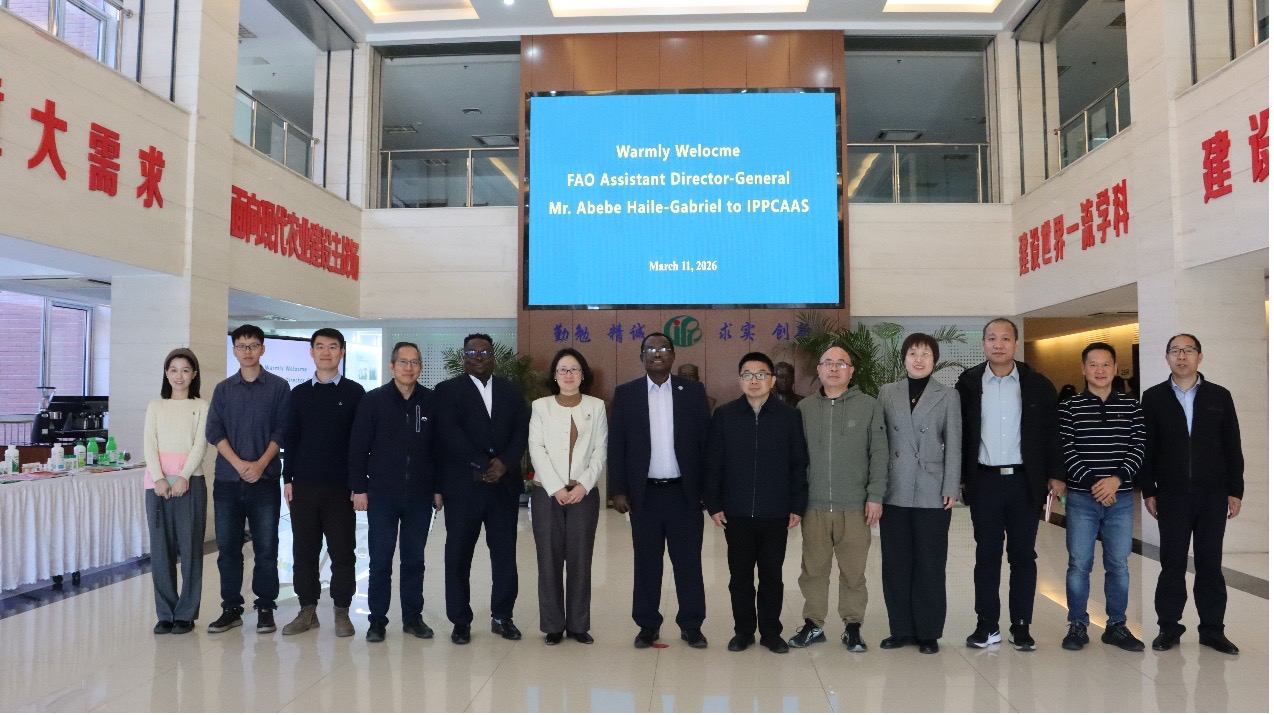 Assistant Director-General of the UN Food and Agriculture Organization Leads Delegation to Visit IPPCAAS
 -
 International Symposium on Plant Biosafety (ISPB 2025) Convenes in Guangzhou — Science-led plant health governance to secure food systems and advance the SDGs
 -
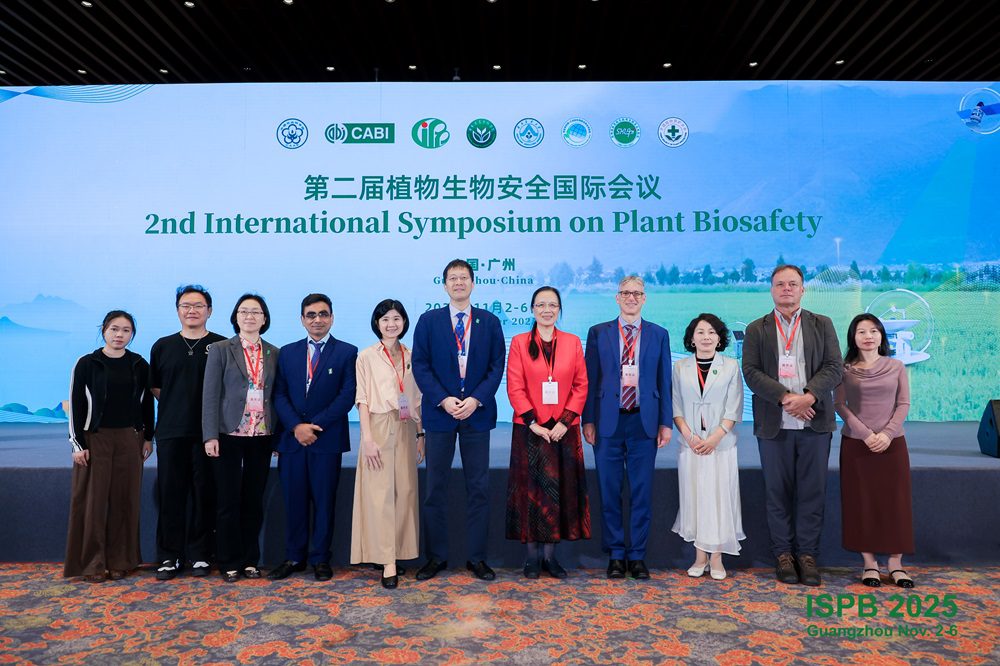 Three decades of China's membership of CABI celebrated at 2nd International Symposium on Plant Biosafety
 -
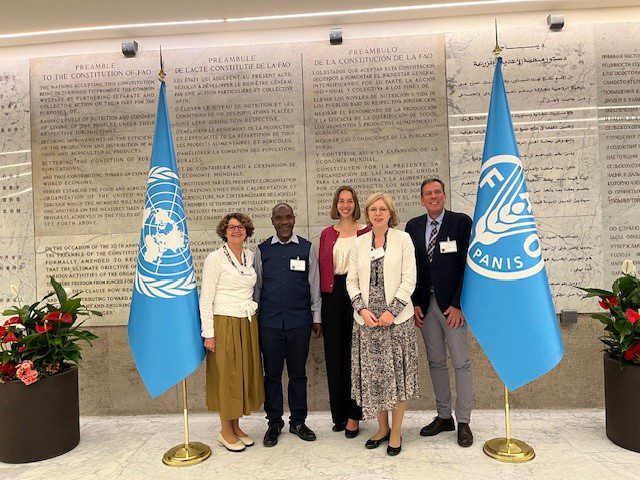 CABI receives recognition from FAO for its work to support sustainable plant production and protection