

IPP Reveals the "Morning Flight-Mating" Rhythmic Behavior of Tuta absoluta and Its Sex Pheromone Regulation Mechanism
Recently, the Innovation Team for Control of Agricultural Invasive Species from the Institute of Plant Protection (IPP), Chinese Academy of Agricultural Sciences (CAAS), published a research paper titled “Rhythmic biosynthesis of sex pheromone modulates the calling and mating behaviors of Tuta absoluta (Lepidoptera: Gelechiidae)” in New Plant Protection. This study systematically reveals the unique “morning flight-mating” behavioral rhythm of the globally significant invasive pest Tuta absoluta (tomato leafminer) and the underlying sex pheromone regulation mechanism, providing new scientific insights and key data support for optimizing green control technologies and improving the control efficiency of this pest.
Tuta absoluta is a worldwide destructive pest infesting Solanaceous crops such as tomatoes, causing yield losses of up to 80%-100% in severe infestations. In recent years, the use of sex pheromones for trapping or mating disruption has become an important green control method. However, insufficient understanding of its courtship and mating behavioral rhythm has led to unclear time windows for the field application of pheromone products, seriously affecting their trapping efficiency and economic benefits. Accurately grasping the time window of its courtship-mating behavior and the corresponding regularity of sex pheromone synthesis and release is crucial for optimizing control strategies and reducing control costs.
Through indoor behavioral observations, this study for the first time detailedly analyzed the “six-step” behavioral pattern of male and female Tuta absoluta moths from resting to post-mating recovery, namely: (1) Resting stage, (2) Preparation stage for morning flight, (3) Morning flight stage, (4) Courtship stage, (5) Mating stage, and (6) Mating cessation. The study clearly indicates that the courtship and mating activities of Tuta absoluta exhibit a strict circadian rhythm, mainly concentrated in the short period after sunrise in the early morning. Under laboratory conditions, the mating peak occurs within the first hour after the start of light (05:30-06:30). This rhythmic behavior is not affected by the placement time of male and female moths on the previous day, reflecting its inherent regulation by the biological clock.
To verify the laboratory observations, the research team further conducted field greenhouse trapping experiments. Results showed that the trapping peak of male moths in the field occurred within 1-2 hours after sunrise (06:30-07:30), which was highly consistent with the mating rhythm observed in the laboratory, confirming the stability of its “morning flight-mating” behavior in natural environments. Additionally, the study found that excessively high population density significantly reduces mating success rate, which may be related to the interference of high-concentration sex pheromones on male moth orientation.
Furthermore, the research team revealed the chemical basis of this behavioral rhythm by determining the 24-hour content changes of two key sex pheromone components (major component TDTA and minor component TDDA) in female moths. The results showed that the rhythm of sex pheromone synthesis and release is highly synchronized with its courtship and mating behavior: the pheromone content reaches a peak before the occurrence of “morning flight-mating” behavior and is rapidly released during the behavior, leading to a sharp decrease in content. This finding confirms that the rhythmic courtship and mating behavior of Tuta absoluta is precisely regulated by the rhythmic biosynthesis and release of sex pheromones.
This study is the first to systematically clarify the “morning flight-mating” behavioral rhythm of Tuta absoluta and its intrinsic mechanism mediated by sex pheromones, providing a clear time window for the precise application of pheromone products. The research results have important practical guiding significance for optimizing pheromone mating disruption or trapping technologies: by precisely and timing the release of pheromones before the mating peak (e.g., in the early morning), it is expected to achieve better control effects at lower costs, opening up a new path for the efficient, economical, and green control of Tuta absoluta.
Luo Minglei, a graduated master student jointly trained by IPP and Yunnan Agricultural University, and Huang Liang, a master student in residence at IPP, are the co-first authors of the paper. Associate Professor Huang Cong and Professor Zhang Yibo are the corresponding authors. Professor Wan Fanghao and Professor Zhang Guifen from IPP, Professor Gui Furong from Yunnan Agricultural University, Professor Arnó Judit from the Institute of Agricultural Technology of Catalonia (IRTA, Spain), and Professor Han Peng from Yunnan University participated in part of the research work. This study was supported by projects including the National Key Research and Development Project of China (Grant No. 2022YFC2601000), the EU-China Horizon Europe ADOPT‐IPM project (Grant No. 101060430), and the Central Public‐Interest Scientific Institution Basal Research Fund (Grant No. S2025XM32).
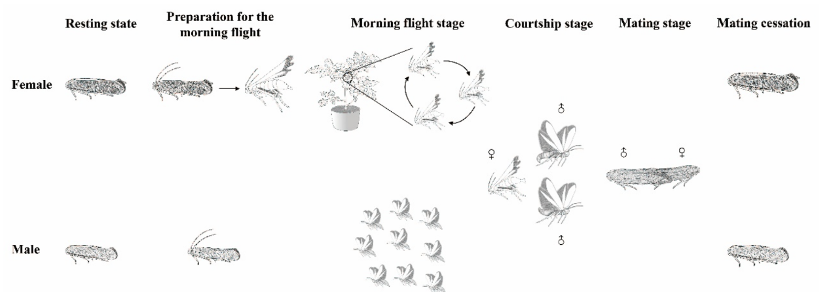
Figure. The "Morning Flight-Mating" Behavioral Pattern of Tuta absoluta Adults
-
 Assistant Director-General of the UN Food and Agriculture Organization Leads Delegation to Visit IPPCAAS
 -
 International Symposium on Plant Biosafety (ISPB 2025) Convenes in Guangzhou — Science-led plant health governance to secure food systems and advance the SDGs
 -
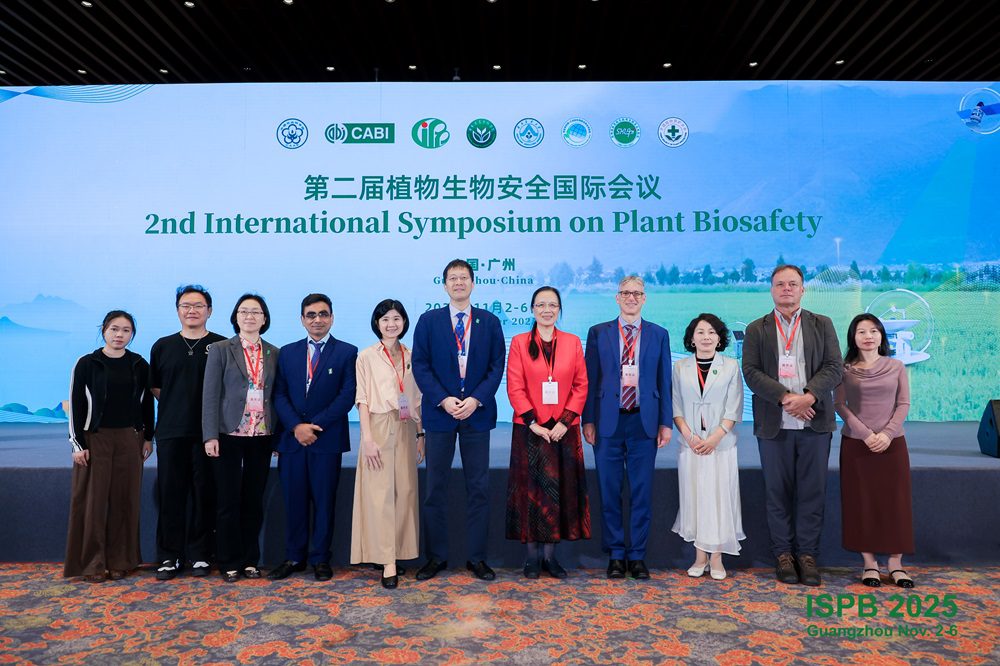 Three decades of China's membership of CABI celebrated at 2nd International Symposium on Plant Biosafety
 -
 CABI receives recognition from FAO for its work to support sustainable plant production and protection