

IPPCAAS Elucidates Environmental Adaptability and Genetic Characteristics of the Invasive Population of the European Grapevine Moth
Recently, the Innovative Team for Prevention and Monitoring of Agricultural Invasive Species at IPPCAAS, published a research paper titled “Genetic structure and global distribution patterns of the European grapevine moth under climate change” in Entomologia Generalis, a top journal in the Chinese Academy of Sciences Journal Ranking. This study integrated population genetics and ecological niche models for the first time to systematically reveal the population genetic structure and invasion characteristics of the European grapevine moth (Lobesia botrana). It identified the potential risk areas for its spread in newly invaded regions, effectively supporting early risk prevention, monitoring, and early warning strategy formulation.
The European grapevine moth is a globally invasive pest that severely damages grape production. It was first confirmed in Xinjiang, China, in 2014. Based on population genetic analysis using the mitochondrial Cytochrome c oxidase subunit I (COI) gene from global and Chinese populations, the study found that the moth can be divided into three main genetic branches: first, an independent branch consisting of populations from the Netherlands; second, a branch primarily composed of populations from the native European regions, such as Italy and Spain, which exhibits rich genetic diversity; and third, a branch mainly consisting of populations from newly invaded areas in Asia, including China and Pakistan. This third branch shows lower genetic diversity, suggesting that the invasion process involved a pronounced genetic bottleneck. Moreover, a new and unique haplotype (Hap24) was identified in Chinese population, indicating adaptive evolution to the local environment. Further analysis combining ecological niche models and demographic history analysis of the European grapevine moth revealed a continuously expanding population trend since the Last Glacial Maximum period. Its potential suitable habitats significantly overlap with global grape-growing regions, posing a high potential threat to grape production worldwide.
Currently, this invasive pest has already caused damage in Turpan City, Xinjiang, China. Additionally, regions such as the Beijing-Tianjin-Hebei Urban Agglomeration and Shandong Province in China are identified as high-risk areas for its establishment. Therefore, it is crucial to strengthen monitoring, early warning, quarantine, interception, and eradication efforts in the leading edges of its spread within China. Strict measures must be taken to prevent its continued expansion within Xinjiang’s major grape-producing areas and its further spread to other grape-growing regions, ensuring the security of Chinese grape industry.
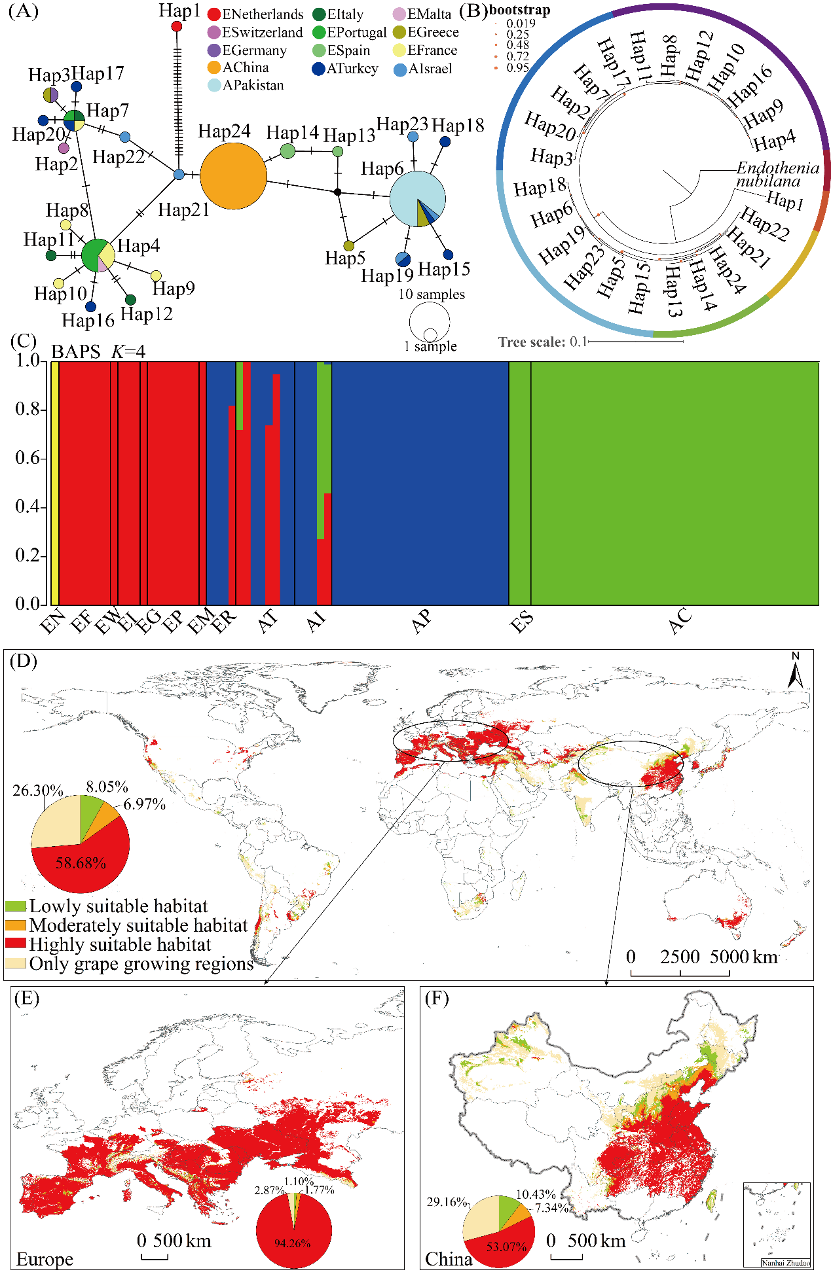
Population Genetic Structure and Potential Risk Areas of the European Grapevine Moth (Lobesia botrana)
Ms. Yang Tianying, a Master’s student at IPPCAAS, is the first author. Researchers Liu Wanxue, Xian Xiaoqing, and Yang Nianwan are the co-corresponding authors. Associate Researcher Guo Jianyang, Dr. Zhao Haoxiang, and Dr. Zhang Yu from IPPCAAS contributed to part of the research. This study was funded by the National Key Research and Development Program of China (2023YFC2605200, 2021YFC2600400) and the Tian-Shan Talent Program (2022TSYCCX0084), among other research projects.
Link: https://doi.org/10.1127/entomologia/3222
-
 Assistant Director-General of the UN Food and Agriculture Organization Leads Delegation to Visit IPPCAAS
 -
 International Symposium on Plant Biosafety (ISPB 2025) Convenes in Guangzhou — Science-led plant health governance to secure food systems and advance the SDGs
 -
 Three decades of China's membership of CABI celebrated at 2nd International Symposium on Plant Biosafety
 -
 CABI receives recognition from FAO for its work to support sustainable plant production and protection